How Proprietary Seismic Bracing Systems Are Changing the Quantity Surveying Equation in the U.S. Construction Market by Shaun Evans

For decades, seismic restraint in commercial ceilings and partition walls across the United States has largely followed the same methodology: site-built wire-and-post bracing systems assembled piece-by-piece in the field.

While these traditional systems remain code compliant when properly installed, they also introduce significant labor intensity, coordination complexity, inspection variability, and program risk — all of which directly impact the Quantity Surveying (QS) and estimating function.

As labor costs continue to rise across the U.S. construction sector, proprietary pre-engineered seismic bracing systems such as BRACELOK® and GRIDLOK® are changing the conversation from simply “material cost” to total installed cost, labor efficiency, and project risk reduction.

For Quantity Surveyors, estimators, and commercial managers, this shift is becoming increasingly important.


The Traditional Seismic Bracing Cost Problem
Conventional seismic ceiling bracing systems typically rely on:

  • Multiple hanger wires

  • Splay wires at prescribed angles

  • Compression struts

  • Numerous field-fabricated connections

  • Larger anchor requirements

  • Extensive layout coordination

  • High installer skill dependency

The traditional “5 wires and a post” methodology commonly used in suspended ceilings is labor intensive and heavily dependent on installer consistency. 

From a QS perspective, this creates several cost pressures:

1. High Installation Labor Hours
Every brace assembly requires multiple separate field operations:

  • Measuring

  • Cutting

  • Bending

  • Wire wrapping

  • Anchor drilling

  • Field fitting

  • Inspection adjustments

In high seismic regions such as California, Nevada, Washington, Oregon, Utah, and Alaska, these labor costs compound rapidly due to increased brace density requirements under ASCE 7 and CBC/HCAI criteria.

2. Coordination Delays in Congested Plenums
Modern commercial ceilings contain:

  • HVAC ductwork

  • Medical gas

  • Electrical containment

  • Fire sprinkler systems

  • Data cabling

  • Lighting systems

Traditional wire-braced systems often compete for the same plenum space, creating clashes and rework. OSHPD/HCAI ceiling standards specifically recognize the need to assess “mechanical duct conflicts and other obstructions” during seismic ceiling design. For Quantity Surveyors, coordination-related delays translate directly into:

  • Extended labor duration

  • Reduced productivity factors

  • Increased supervision costs

  • Program risk exposure


The Proprietary System Advantage
Pre-engineered proprietary systems such as GRIDLOK® fundamentally change the installation methodology. Rather than assembling multiple independent field components, GRIDLOK® replaces the traditional system with a prefabricated rigid brace assembly designed specifically for suspended ceiling applications. The system is HCAI preapproved under OPM-0544 for suspended ceiling bracing applications in California healthcare and DSA environments. Similarly, BRACELOK® wall bracing systems are preapproved under OPM-0377 for partition wall seismic restraint applications. For QS professionals, the implications are substantial.

1. Reduced Installed Labor
One of the most immediate commercial advantages is labor reduction.

GRIDLOK®:

  • Eliminates the traditional “5 wires and a post” arrangement

  • Uses prefabricated connection geometry

  • Requires fewer field-fabricated components

  • Simplifies installation sequencing

The manufacturer documentation specifically identifies:

“LABOR SAVINGS: This is a prefabricated solution with screw holes already predrilled, requiring a lower skill level to install, and is easier to inspect.” 

This has direct QS implications:

  • Lower labor hours per brace point

  • Reduced skilled labor dependency

  • Faster installation rates

  • Lower supervision requirements

  • Reduced inspection correction costs

In a market where skilled ceiling mechanics are increasingly difficult to source, this becomes a major commercial advantage.

2. Fewer Brace Locations Required
Traditional seismic ceiling systems often require dense brace spacing in high seismic regions. Proprietary rigid brace systems can significantly reduce the number of installed brace assemblies required per square foot.

GRIDLOK® documentation states:

“3 conventional installs for every 2 GRIDLOK® installs.” 

For Quantity Surveyors, this affects:

  • Material quantities

  • Anchor counts

  • Labor duration

  • Drill time

  • Layout time

  • Inspection scope

The cumulative savings become particularly significant on:

  • Healthcare projects

  • Airports

  • Data centers

  • Laboratories

  • Large education facilities

  • Distribution centers

3. Reduced Anchor Costs and Structural Risk
Anchor installation is often underestimated in seismic estimating. Traditional systems may require:

  • Larger anchors

  • Deeper embedments

  • Increased drilling duration

  • Greater risk of reinforcing steel strikes

By comparison, proprietary systems can reduce anchorage demands.

GRIDLOK® documentation notes:

“1/2” expansion anchors can be used up to an SDS of 2.0, in most cases with just 2” of embedment.” 

For estimators and QS teams, shallower embedment means:

  • Faster drilling

  • Reduced consumables

  • Lower tool wear

  • Reduced concrete scanning requirements

  • Lower rework exposure

On healthcare projects operating under HCAI requirements, reducing anchor risk is commercially significant due to stringent inspection and compliance processes. 

4. Improved Installation Predictability
One of the hidden costs in conventional seismic systems is variability. Traditional wire-braced systems are highly installer-dependent. Two crews can produce dramatically different productivity outcomes. Prefabricated proprietary systems improve:

  • Installation repeatability

  • Inspection consistency

  • Predictable labor outputs

  • Standardized workflows

This improves estimator confidence when developing:

  • Labor production rates

  • Bid allowances

  • Contingency calculations

  • Schedule forecasts

For Quantity Surveyors, predictability is often more valuable than theoretical material savings.

5. Reduced Program Risk
Program certainty is increasingly critical in U.S. commercial construction. Delays associated with failed inspections, rework, coordination conflicts, field engineering and anchor remediation can rapidly erode project margin. Pre-engineered systems with HCAI preapproval simplify approval pathways and reduce uncertainty on regulated projects. This is particularly relevant in:

  • California healthcare

  • DSA school projects

  • Essential facilities

  • Seismic Design Category D, E, and F projects

For Quantity Surveyors, reduced risk exposure translates directly into:

  • More reliable forecasting

  • Reduced contingency allocation

  • Improved margin protection


Why This Matters More in the U.S. Market
The U.S. construction market faces several converging pressures:

  • Skilled labor shortages

  • Increasing prevailing wage rates

  • Higher seismic compliance requirements

  • More congested building services

  • Accelerated construction schedules

  • Greater inspection scrutiny

At the same time, seismic compliance requirements under IBC, ASCE 7, CBC, HCAI and DSA continue to become more rigorous. Proprietary seismic bracing systems are increasingly being evaluated not simply as “products,” but as labor-efficiency tools and risk-management solutions. That distinction matters enormously to modern Quantity Surveying practice.


The Shift from Material Cost to Installed Cost
Historically, seismic bracing procurement decisions were often based primarily on material pricing. Today, sophisticated estimators are evaluating:

  • Installed labor cost

  • Coordination impacts

  • Schedule compression

  • Inspection efficiency

  • Workforce availability

  • Rework exposure

  • Risk transfer

This broader lifecycle approach increasingly favors pre-engineered proprietary systems. For many projects, especially in high seismic regions, the cheapest material solution is no longer the lowest project cost solution.


Conclusion
The evolution of proprietary seismic bracing systems such as BRACELOK® and GRIDLOK® reflects a broader shift occurring across the U.S. construction industry:

From:

  • Field-built

  • Labor-heavy

  • Variable installations

To:

  • Engineered

  • Prefabricated

  • Predictable systems

For Quantity Surveyors, estimators, and commercial managers, the value proposition extends far beyond hardware pricing. The real advantage lies in:

  • Reduced labor

  • Faster installation

  • Lower coordination burden

  • Improved compliance certainty

  • Reduced inspection risk

  • Greater program predictability

In today’s seismic construction environment, proprietary bracing systems are increasingly becoming a commercial strategy - not simply a technical specification.

Exciting Updates for BRACELOK® in the USA by Shaun Evans

There’s an important update regarding BRACELOK® in the USA. Our previous distribution arrangement has concluded, but rest assured - the BRACELOK® and GRIDLOK® products you trust remains available, and our dedicated team is here to support you. 

As always, our online store is open and ready for business.

We understand that transitions take time, and we truly appreciate your patience. Our expert technical team and customer support staff are ready to assist you with any questions, orders, or project needs.

We’d love to hear from you!
Let us know what projects you have coming up and how we can help - whether with product, support, or both. Your success is our priority, and we are committed to ensuring a smooth and seamless experience. If you need technical support, access it here.

Thank you for your continued trust in BRACELOK® and GRIDLOK®. The future is bright, and we are excited to be #FutureReady with you.

ENR California’s Best Projects Awards by Shaun Evans

McCarthy’s Northern Pacific Region is proud to announce our UC Davis Health Rehabilitation Hospital project as one of ENR California’s Best Projects Awards of Merit for 2023!

Projects were evaluated on the following criteria: overcoming challenges, teamwork, safety, innovation, quality, and functionality of design. With zero recordables on more than 230,000 hours of work, this project was successfully turned over to the client safely.

Congratulations to the project team on this well-deserved award!

We were pleased to have GRIDLOK®, our ceiling seismic bracing product installed by Nevell Group throughout this project.

The High Cost of Building California Hospitals by Shaun Evans

Price tag can be two times higher than in nearly any other state

Gas, groceries, homes, furniture, even movies cost more in San Diego than in other places. Through the years we’ve come to call it the “sunshine tax” — the price we pay for living in America’s Finest City.

When it comes to building new hospitals, the cost difference is even greater. Data show the price tag for building a new hospital in California can be more than twice the cost than in nearly any other state. 

The average US construction cost for a 500,000-square-foot modern tertiary hospital, for example, is about $325 million. A similar hospital built in San Diego or Los Angeles would cost more than $700 million to complete. 

“Every element of hospital construction is more expensive in California,” says Sasan Asadyari, a director of corporate construction at Scripps. “It begins with land, construction, labor costs and extensive permitting, and then continues with materials, supplies, HVAC and electrical systems, medical equipment and, of course, adherence to stringent California seismic standards.” 

Strict seismic standards
Those seismic standards are meant to keep hospitals not only standing, but fully operational during and after a large earthquake. They’re part of California’s Senate Bill 1953, an unfunded mandate that requires all hospitals in the state to meet strict seismic requirements or to rebuild no later than 2030. 

Despite inflationary pressures and today’s challenging health care markets, the law has spurred a surge in hospital construction as health systems like Scripps work to meet community needs and the state deadline. 

Hospital construction is under way at Scripps Memorial Hospital La Jolla and Scripps Memorial Hospital Encinitas. And a master plan for the campus of Scripps Mercy Hospital San Diego, calls for a replacement hospital that will cost upward of $1.2 billion, all costs included. 

“As hospital buildings in the state begin to age, replacing them has become a significant financial burden,” agrees Chris Van Gorder, Scripps president and CEO. “We’re facing tight seismic deadlines, higher labor costs and supply chain delays; and it’s all happening in this ‘new normal’ of staffing shortages, an increased need for care, challenged reimbursement and some of the highest inflation levels in the country.” 

“It’s a difficult time to be in the health care business,” Van Gorder adds. “The level of construction we’re seeing today is only the result of years of careful financial planning, as well as the generosity of those in our community who are able and willing to give to help ensure high quality health care for future generations.” 

What makes California hospitals different? 
“I think people would be surprised to hear that something like permitting can cost more than $8 million,” says Asadyari, who is managing construction of the new hospital tower at Scripps La Jolla. “This includes permits in advance of construction, permits required at various stages of construction, school district permits and funds for needed permit changes or amendments.” 

While every state requires permits for hospital construction, California’s seismic standards can make the process more complex. 

Materials purchased to construct a hospital or be installed within it must be “shaker test” certified, meaning they must retain their structural integrity during small and large tremors. Electrical panels, air handling equipment and other significant equipment in a hospital must be built and installed to withstand a large earthquake. 

All these requirements must be met before we even get to sophisticated medical equipment, specialized operating room lights and standard necessities, like patient beds. 

Then there are the seismic requirements for construction itself: 

  • Depending on the seismic zone a hospital is being built within, some structural beams can be as much as four times larger and stronger than standard beams used elsewhere. 

  • Specialized spring assemblies are needed to act as shock absorbers for piping and other systems. 

  • Extensive seismic bracing must be installed to support metal piping used for electrical conduit and plumbing. 

  • Multiple redundancies must be in place for water, sewage, heating, air circulation and other critical systems. 

The actual list of requirements is, of course, much longer. It takes hundreds of construction professionals to build, secure, build some more and then go over it all again to add the necessary brackets, plates and even more safety measures. It’s a well-choreographed process that ensures everything is completed in the right order and at the right time. 

“For the comfort and safety of our patients and our staff, Scripps works with some of the best construction companies out there to ensure we end up with the best and safest buildings we can build,” says Asadyari. 

In California, it all just costs more. 

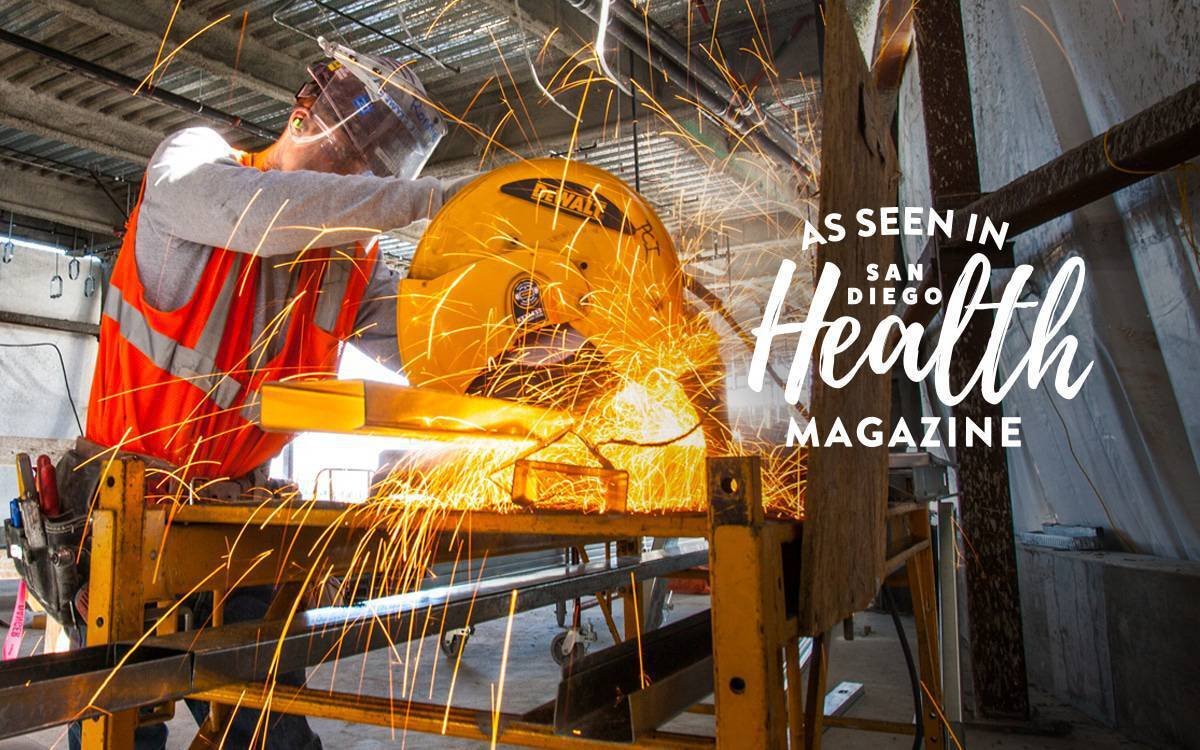
This content appeared in San Diego Health, a publication in partnership between Scripps and San Diego Magazine that celebrates the healthy spirit of San Diego.

Bracelok enews - January 2023 by Shaun Evans

As we begin the new year, we want to thank our customers, our installing partners, architects, engineers, hospital groups, school districts, community colleges, and wall and ceiling manufacturers who help make our business successful. 

Here are the latest product enhancements we have made to our GRIDLOK® OPM for suspended ceiling bracing:

1. INCREASED RANGE
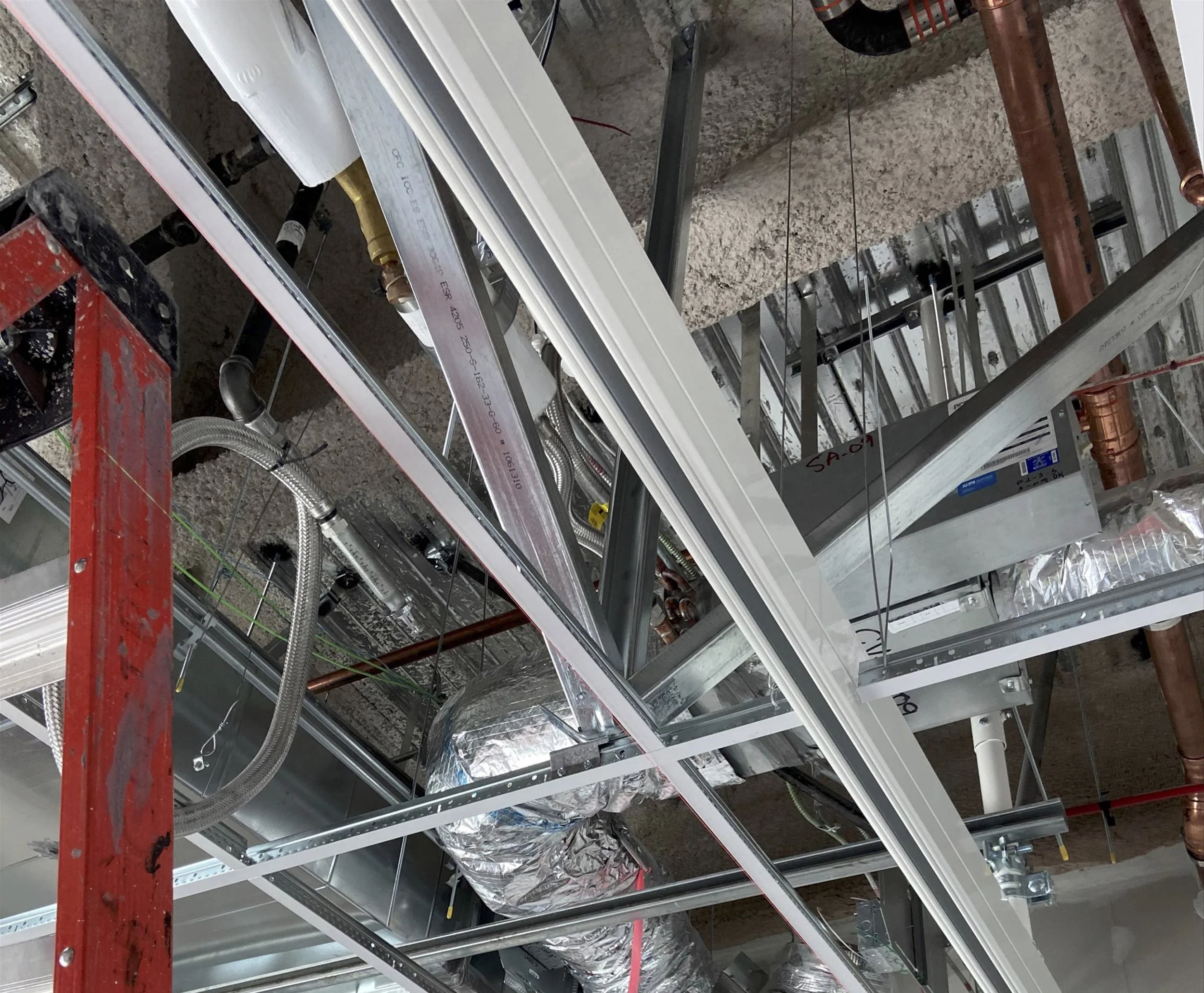
Increased the range of bracing to walls to 0° to 60° - this is the most flexible of any approved solution. The addition to the product range of BC-30s make this possible. See the photo below of an installation at one of two Kaiser Permanente projects that have used the BC-30 option. You can see here that the compression post is in its usual position. One brace attached to the post goes to the BC-30 wall bracket sitting inside the 600S, while the other brace goes to the deck. 

2. ADVANCESPAN INTEGRATION
We’ve added integration with USG’s corridor product Advancespan. This combination enables crowded corridors to have zero wires and using GRIDLOK®, just a single brace, and a post. See our description of this solution at Kindred UC Davis Healthcare Rehabilitation Hospital.

3. MULTIPLE LAYERS OF GYPSUM BOARD SCREW DETAIL
We've added the screw details for the situation where there are multiple layers of gypsum board (sheets 15A and 15B of our latest OPM) which is dated 12/20/2022.


Customer feedback

With significant new sites during the year, it’s always great to get applause from our installer community. On the successful completion of the Crawford High School project, where we worked closely with Turner Construction, Gary Turner at CMS had this to say: 

“We used GRIDLOK® seismic ceiling bracing brackets with great success on a ground-up multistory DSA high school project here in San Diego. Due to the extremely crowded overhead conditions, using conventional methods with a seismic post and four splay wires would have been extremely difficult and time-consuming.

GRIDLOK® requires only two brace arms and an integrated compression post. With the ability to rotate the grid clip and adjust the angle of the braces, we achieved code-compliant seismic bracing with less cost and time. 

I recommend GRIDLOK® seismic ceiling bracing for any DSA school or HCAI (OSHPD) hospital project. A huge bonus was the lead time - once they were ordered, we received all shipments into our warehouse within two days of placing the orders. 

I also can’t say enough about how great the technical support is. They are extremely knowledgeable about their product capability and provided valuable documents right away, so we were able to get these approved for the project.

They’ve done their homework and have the testing and engineering to back it up.” 

Gary Turner CMS Interiors 


Finally…

Those attending “CASH” in Sacramento February 22-24, we look forward to seeing you!

Why hospitals are struggling to meet earthquake safety deadline by Shaun Evans

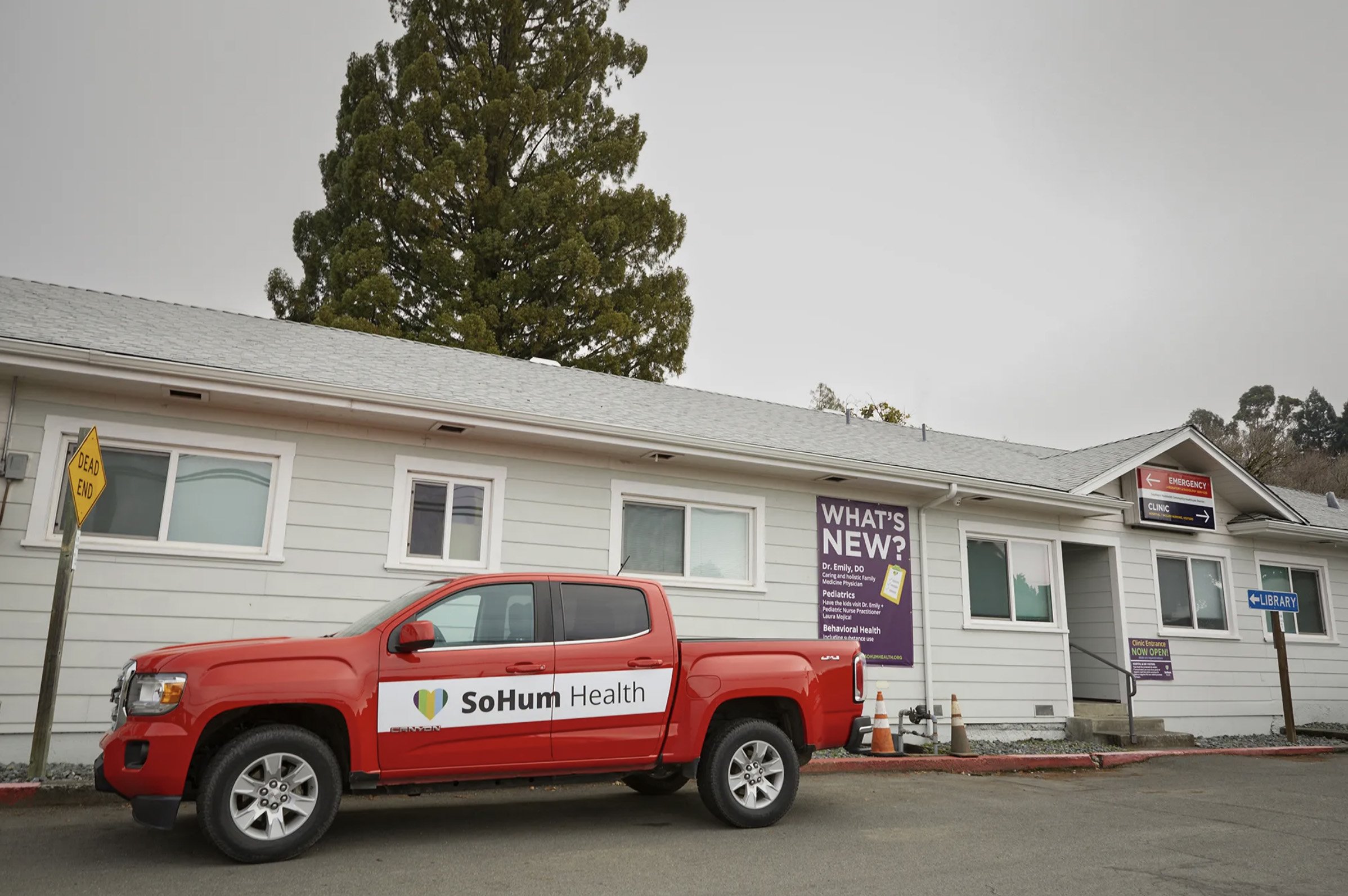
The Jerold Phelps Community Hospital operated by SoHum Health in Garberville on Dec. 17, 2022. Photo by Paul Collins for CalMatters

It’s been close to 30 years since California enacted the bulk of its seismic safety standards, but hospitals continue to ask for more time and flexibility. They argue that many facilities, especially smaller ones, can’t afford the retrofitting or replacement costs.

Jerold Phelps Community Hospital in Garberville, California is one of the smallest in the country. Its mere nine acute-care beds serve a community of about 10,000 people in southern Humboldt County. The next closest emergency room is about an hour’s drive north.

Despite its small size, the hospital is facing a hefty price tag to meet the 2030 retrofit deadline required under the state’s seismic safety standards - about $50 million for a new single story hospital that would replace its 1960s building.

Although it’s been decades since California implemented its strict seismic safety requirements, paying for those upgrades continues to be a tough task, especially for smaller facilities with limited resources and funding, according to hospital officials across the state. Like Jerold Phelps Community Hospital, two-thirds of California hospitals have yet to meet the looming state seismic deadline that requires hospital buildings to be updated to ensure they can keep operating after an earthquake.

The 6.4 magnitude quake that struck the Humboldt area on Dec. 20 was a stark reminder of California’s vulnerability to seismic activity. Hospitals in the county reported minimal damage and no threat to patients. Two hospitals, in Eureka and Fortuna, lost power and needed generators, according to the California Office of Emergency Services.

Hospital administrators acknowledge their buildings need to remain safe and available for emergency services following a quake, but they say they need more time to complete their upgrades and construction projects, especially as many are still reeling from the financial strains of responding to the COVID-19 pandemic. Officials at smaller hospitals say that in addition to time, they need funding. They also want more flexibility. The Legislature, they say, should revisit the rules and grant them more leeway for buildings that provide non-emergency services.

“Everyone wants to make our hospitals safe - that’s not the issue. It’s just a tremendous amount of capital that is being poured into this,” said Debi Stebbins, executive director at the City of Alameda Health Care District, which oversees Alameda Hospital.

The seismic safety standards debate is a familiar one in Sacramento, and one that hospital administrators expect will come up again during this new legislative term. Officials at the California Hospital Association said their immediate goal is to educate the large new class of lawmakers about the state’s seismic safety laws and the challenges hospitals face.

Labor groups, however, have strongly opposed hospitals’ ongoing requests for deadline extensions and amendments. They argue that hospitals have had plenty of time - about 30 years - to bring their buildings up to the required standards.

“They have had many, many, many years to do this, and to now say they need an extension is just not appropriate,” said Cathy Kennedy, president of the California Nurses Association. “I think they can do it.”

Read the full article here

Scripps Encinitas Acute Care Center by Shaun Evans

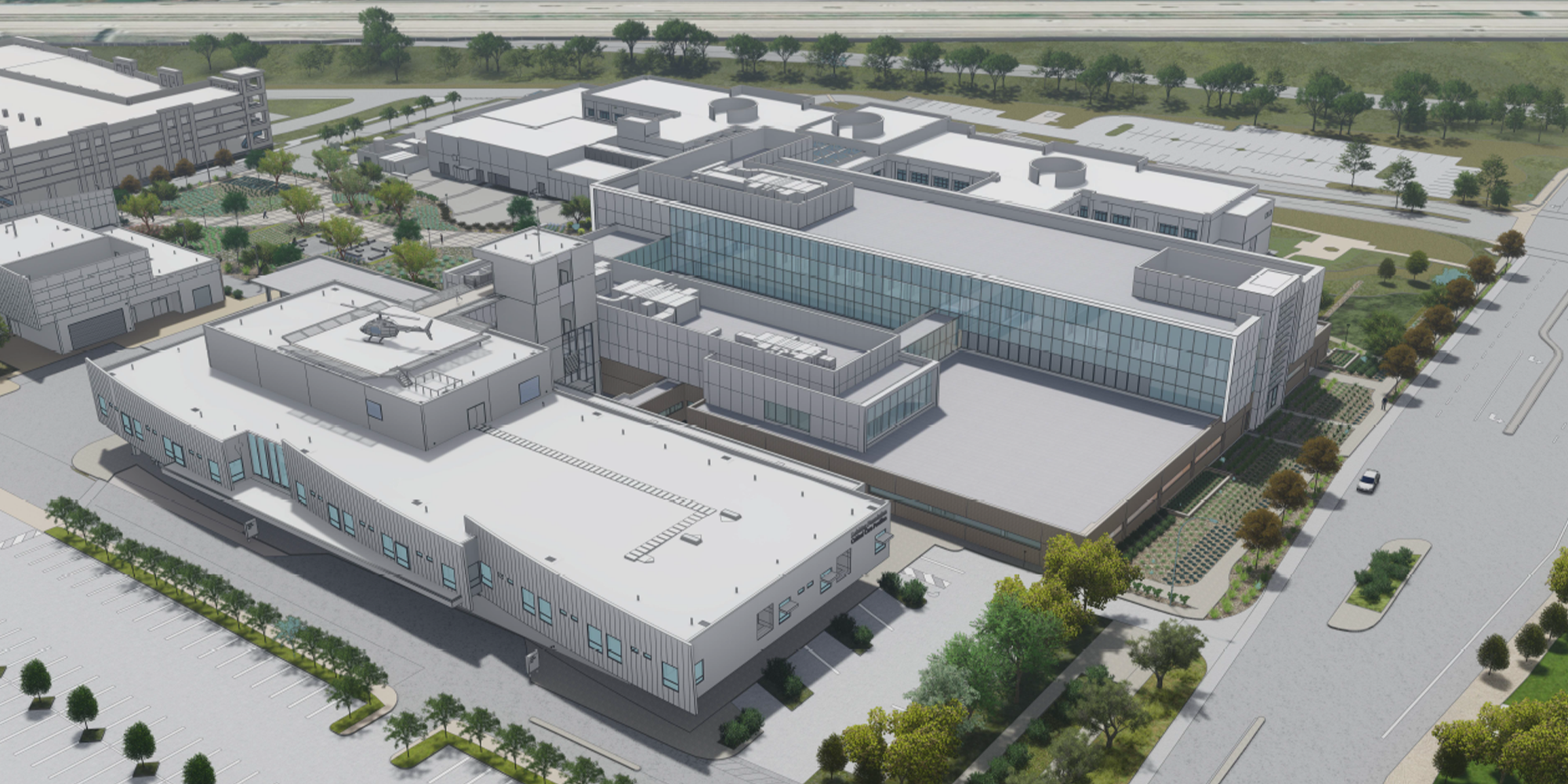
A three-story acute care building located in the middle of an existing campus. The Scripps Encinitas project is the phased decommissioning and demolition of existing buildings 1, 2, 4, 6, 7, and 8 with the phased construction of a new three-story, 224,000sf Acute Care Building. This work includes the expansion of the existing Critical Care Building Central Energy Plant, a new loading dock, and new landscaping and hardscape on- and off-site improvements. The project includes phased construction of 92,000sf new construction and 90,854sf of rebuilt hospital space. This also includes the expansion of the existing critical care building central energy plant and a new loading dock. Completion due 2030.

6.4-Magnitude Earthquake Shakes Northern California by Shaun Evans

The quake was reported around 2:30 a.m. local time. Tens of thousands of customers were without power.

FORTUNA, Calif. — A 6.4-magnitude earthquake shook Humboldt County in Northern California early Tuesday morning, the United States Geological Survey reported, injuring at least two people, damaging homes and roads and leaving more than 70,000 customers without electricity.

Emergency authorities were still assessing the destruction as light rain fell in the heavily forested region of rural Northern California, where the quake struck in the frigid dark at 2:34 a.m. local time about 12 miles west of Ferndale. By 5 a.m., poweroutage.us reported that about 72,000 customers in Humboldt County, about 72 percent of the total customers there, were without power. The oceanside county is more than 200 miles north of San Francisco in a seismically active area.

The Humboldt County Sheriff’s Office said no tsunami was anticipated, but reported “widespread” damage. Officials asked people to avoid calling 911 unless they were experiencing an immediate emergency.

There were more than two dozen aftershocks by 4 a.m., including at least five that were magnitude 3 or higher, the U.S.G.S. reported.

Read the full article here