
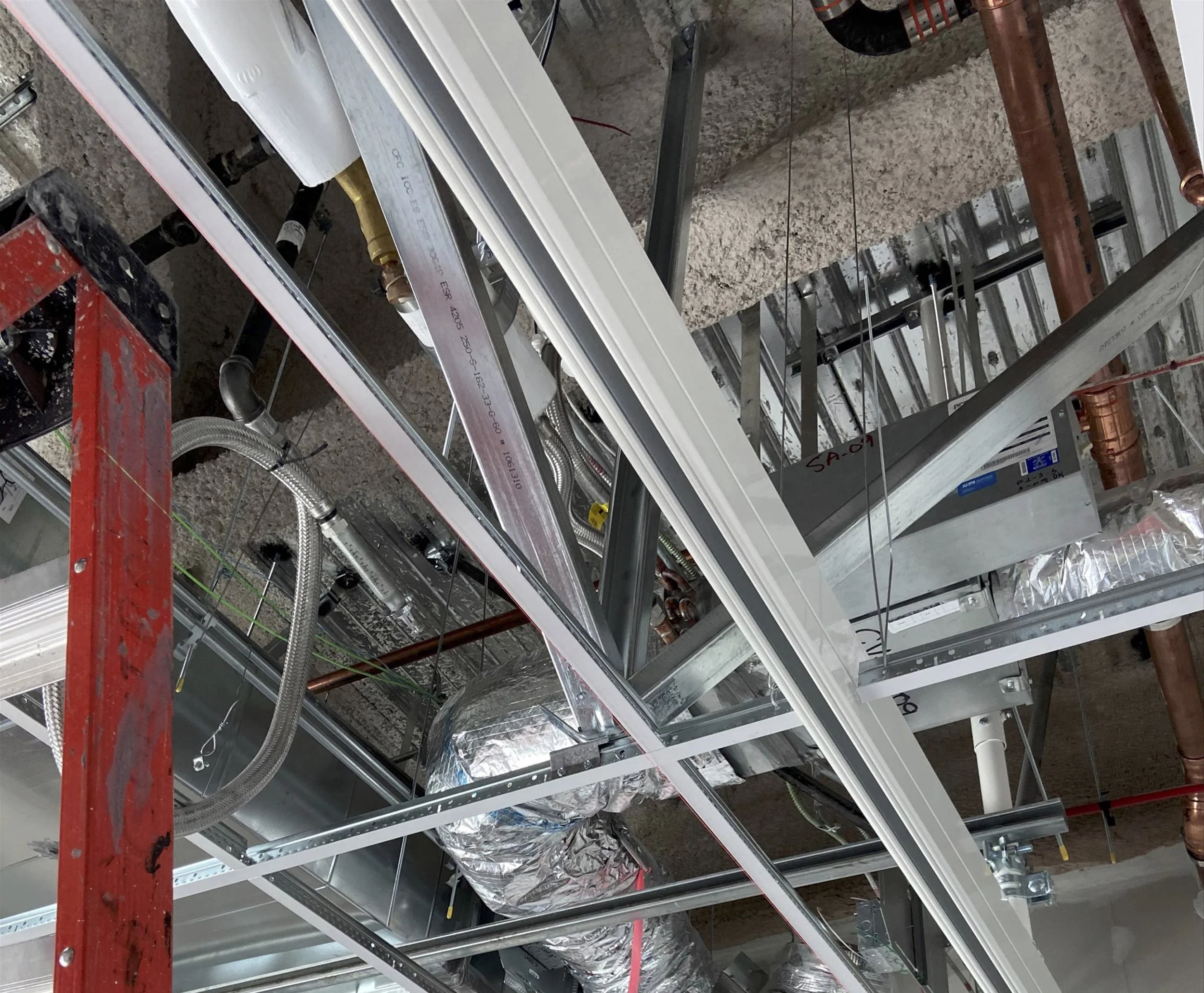
For decades, seismic restraint in commercial ceilings and partition walls across the United States has largely followed the same methodology: site-built wire-and-post bracing systems assembled piece-by-piece in the field.
While these traditional systems remain code compliant when properly installed, they also introduce significant labor intensity, coordination complexity, inspection variability, and program risk — all of which directly impact the Quantity Surveying (QS) and estimating function.
As labor costs continue to rise across the U.S. construction sector, proprietary pre-engineered seismic bracing systems such as BRACELOK® and GRIDLOK® are changing the conversation from simply “material cost” to total installed cost, labor efficiency, and project risk reduction.
For Quantity Surveyors, estimators, and commercial managers, this shift is becoming increasingly important.
The Traditional Seismic Bracing Cost Problem
Conventional seismic ceiling bracing systems typically rely on:
Multiple hanger wires
Splay wires at prescribed angles
Compression struts
Numerous field-fabricated connections
Larger anchor requirements
Extensive layout coordination
High installer skill dependency
The traditional “5 wires and a post” methodology commonly used in suspended ceilings is labor intensive and heavily dependent on installer consistency.
From a QS perspective, this creates several cost pressures:
1. High Installation Labor Hours
Every brace assembly requires multiple separate field operations:
Measuring
Cutting
Bending
Wire wrapping
Anchor drilling
Field fitting
Inspection adjustments
In high seismic regions such as California, Nevada, Washington, Oregon, Utah, and Alaska, these labor costs compound rapidly due to increased brace density requirements under ASCE 7 and CBC/HCAI criteria.
2. Coordination Delays in Congested Plenums
Modern commercial ceilings contain:
HVAC ductwork
Medical gas
Electrical containment
Fire sprinkler systems
Data cabling
Lighting systems
Traditional wire-braced systems often compete for the same plenum space, creating clashes and rework. OSHPD/HCAI ceiling standards specifically recognize the need to assess “mechanical duct conflicts and other obstructions” during seismic ceiling design. For Quantity Surveyors, coordination-related delays translate directly into:
Extended labor duration
Reduced productivity factors
Increased supervision costs
Program risk exposure
The Proprietary System Advantage
Pre-engineered proprietary systems such as GRIDLOK® fundamentally change the installation methodology. Rather than assembling multiple independent field components, GRIDLOK® replaces the traditional system with a prefabricated rigid brace assembly designed specifically for suspended ceiling applications. The system is HCAI preapproved under OPM-0544 for suspended ceiling bracing applications in California healthcare and DSA environments. Similarly, BRACELOK® wall bracing systems are preapproved under OPM-0377 for partition wall seismic restraint applications. For QS professionals, the implications are substantial.
1. Reduced Installed Labor
One of the most immediate commercial advantages is labor reduction.
GRIDLOK®:
Eliminates the traditional “5 wires and a post” arrangement
Uses prefabricated connection geometry
Requires fewer field-fabricated components
Simplifies installation sequencing
The manufacturer documentation specifically identifies:
“LABOR SAVINGS: This is a prefabricated solution with screw holes already predrilled, requiring a lower skill level to install, and is easier to inspect.”
This has direct QS implications:
Lower labor hours per brace point
Reduced skilled labor dependency
Faster installation rates
Lower supervision requirements
Reduced inspection correction costs
In a market where skilled ceiling mechanics are increasingly difficult to source, this becomes a major commercial advantage.
2. Fewer Brace Locations Required
Traditional seismic ceiling systems often require dense brace spacing in high seismic regions. Proprietary rigid brace systems can significantly reduce the number of installed brace assemblies required per square foot.
GRIDLOK® documentation states:
“3 conventional installs for every 2 GRIDLOK® installs.”
For Quantity Surveyors, this affects:
Material quantities
Anchor counts
Labor duration
Drill time
Layout time
Inspection scope
The cumulative savings become particularly significant on:
Healthcare projects
Airports
Data centers
Laboratories
Large education facilities
Distribution centers
3. Reduced Anchor Costs and Structural Risk
Anchor installation is often underestimated in seismic estimating. Traditional systems may require:
Larger anchors
Deeper embedments
Increased drilling duration
Greater risk of reinforcing steel strikes
By comparison, proprietary systems can reduce anchorage demands.
GRIDLOK® documentation notes:
“1/2” expansion anchors can be used up to an SDS of 2.0, in most cases with just 2” of embedment.”
For estimators and QS teams, shallower embedment means:
Faster drilling
Reduced consumables
Lower tool wear
Reduced concrete scanning requirements
Lower rework exposure
On healthcare projects operating under HCAI requirements, reducing anchor risk is commercially significant due to stringent inspection and compliance processes.
4. Improved Installation Predictability
One of the hidden costs in conventional seismic systems is variability. Traditional wire-braced systems are highly installer-dependent. Two crews can produce dramatically different productivity outcomes. Prefabricated proprietary systems improve:
Installation repeatability
Inspection consistency
Predictable labor outputs
Standardized workflows
This improves estimator confidence when developing:
Labor production rates
Bid allowances
Contingency calculations
Schedule forecasts
For Quantity Surveyors, predictability is often more valuable than theoretical material savings.
5. Reduced Program Risk
Program certainty is increasingly critical in U.S. commercial construction. Delays associated with failed inspections, rework, coordination conflicts, field engineering and anchor remediation can rapidly erode project margin. Pre-engineered systems with HCAI preapproval simplify approval pathways and reduce uncertainty on regulated projects. This is particularly relevant in:
California healthcare
DSA school projects
Essential facilities
Seismic Design Category D, E, and F projects
For Quantity Surveyors, reduced risk exposure translates directly into:
More reliable forecasting
Reduced contingency allocation
Improved margin protection
Why This Matters More in the U.S. Market
The U.S. construction market faces several converging pressures:
Skilled labor shortages
Increasing prevailing wage rates
Higher seismic compliance requirements
More congested building services
Accelerated construction schedules
Greater inspection scrutiny
At the same time, seismic compliance requirements under IBC, ASCE 7, CBC, HCAI and DSA continue to become more rigorous. Proprietary seismic bracing systems are increasingly being evaluated not simply as “products,” but as labor-efficiency tools and risk-management solutions. That distinction matters enormously to modern Quantity Surveying practice.
The Shift from Material Cost to Installed Cost
Historically, seismic bracing procurement decisions were often based primarily on material pricing. Today, sophisticated estimators are evaluating:
Installed labor cost
Coordination impacts
Schedule compression
Inspection efficiency
Workforce availability
Rework exposure
Risk transfer
This broader lifecycle approach increasingly favors pre-engineered proprietary systems. For many projects, especially in high seismic regions, the cheapest material solution is no longer the lowest project cost solution.
Conclusion
The evolution of proprietary seismic bracing systems such as BRACELOK® and GRIDLOK® reflects a broader shift occurring across the U.S. construction industry:
From:
Field-built
Labor-heavy
Variable installations
To:
Engineered
Prefabricated
Predictable systems
For Quantity Surveyors, estimators, and commercial managers, the value proposition extends far beyond hardware pricing. The real advantage lies in:
Reduced labor
Faster installation
Lower coordination burden
Improved compliance certainty
Reduced inspection risk
Greater program predictability
In today’s seismic construction environment, proprietary bracing systems are increasingly becoming a commercial strategy - not simply a technical specification.